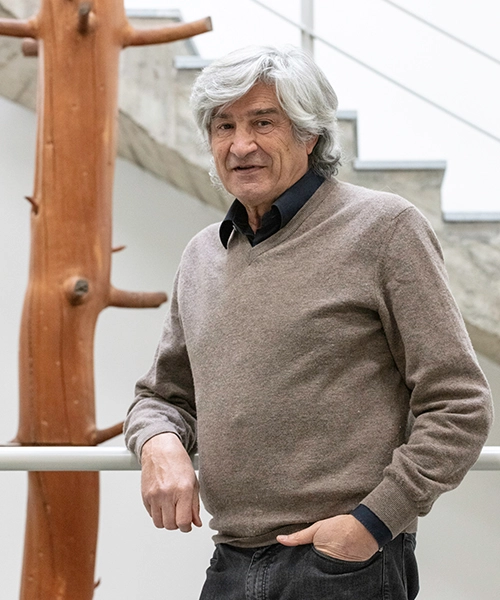

To mark his 80th birthday, the Von der Heydt Museum is bringing one of the most successful and significant artists of the Arte Povera movement back to Germany for a solo exhibition for the first time in many years: Giuseppe Penone. Since the late 1960s, Penone has developed a complex and multi-layered body of work comprising sculptures, installations, works on paper and photographs, whose central themes are nature and the human body, as well as the interaction between humankind and nature. At the Von der Heydt Museum, under the title ‘Blind Images’, Penone highlights the tension between seeing and touching, which fundamentally defines his art. The exhibition comprises major works from several decades, including his latest pieces and installations created specifically on site.
Penone was born in 1947 in the Italian village of Garessio (Piemont); his family worked in agriculture and his grandfather was a sculptor. He began drawing as a child and was fascinated by plants and their growth – a motif he later incorporated into his sculpture. After finishing school, Penone enrolled at the Accademia Albertina, the state art college in Turin, in 1966, but dropped out after a year, feeling disillusioned. He returned to his home town. There, during the winter months of 1967–68, he carried out a series of actions in the surrounding forests, which he documented photographically and which are now regarded as his first body of work: ‘Alpi Marittime’ (Maritime Alps). It was here that the now legendary work ‘Continuerà a crescere tranne che in quel punto’ (It will continue to grow, except at that point) was created. It consists of a metal hand, modelled on Penone’s own, clasping the trunk of an ash tree.
The tree is one of the most important motifs in Penone’s work; he regards it as a symbol of the analogy between humankind and nature. Like humankind, the tree is subject to a progressive life cycle, and like humankind, every tree is unique, its history inscribed in its appearance.
Penone’s work has been exhibited and honoured internationally on numerous occasions; in 2014 he was awarded the Praemium Imperiale, and in 2023 he received the Antonio Feltrinelli Prize.
The exhibition in Wuppertal covers a wide range, from early works dating from 1970 to recent pieces, including two well-known tree sculptures, as well as photographic, installation, graphic and painterly works. A particular highlight is a large-scale wall piece created in situ.
| Parking garage | Opening Hours | |
|---|---|---|
| Fleming’s Express | Mon to Sun | Open 24 hours |
| Tue to Sun | 07:30 a.m. – 01:30 p.m. | |
| Karlsplatz | Mon to Sun | 06:00 a.m. – 23:00 p.m. |
| CityArkaden | Mon to Sat | 07:30 a.m. – 20:30 p.m. |
| Sun | 12:00 a.m. – 18:00 p.m. | |
| Neumarkt | Mon to Sat | 06:30 a.m. – 23:30 p.m. |
| Sou | 08:30 a.m. – 20:30 p.m. | |
| St Josef / Bergstraße | Mon to Sun | 07:00 a.m. – 23:00 p.m. |
| Ohligsmühle / Vapiano | Mon to Sun | 06:00 a.m. – 23:00 p.m. |
| Galeria Kaufhof Neumarkstraße | Mon to Fri | 09:30 a.m. – 20:30 p.m. |
| Sat | 09:30 a.m. – 19:00 p.m. | |
| Sun | closed | |
| Hofaue City | Mon to Sat | 06:00 a.m. – 22:00 p.m. |
| Sun | Geschlossen | |
| Teijin | Mon to Sun | Open 24 hours |
| Kleine Klotzbahn | Mon to Sun | Open 24 hours |
| Hautpbahnhof | Mon to Sun | Open 24 hours |
To get on and off the bus, please use the stop in Südstraße
School Bus stop Stadthalle (Bahnhofstraße), Mon to Fri after 2 p.m., Sat, Sun and holidays. You can also park here during school holidays
Böttinger Weg (at the zoo)
We are delighted to welcome you to the Von der Heydt Museum and hope you enjoy your visit. The house rules are binding for both visitors and all employees of the Von der Heydt Museum. By entering the museum building, you agree to comply with our house rules and all other regulations designed to maintain operational safety.
From highway A 46, take the exit W-Katernberg or W-Elberfeld.
Follow the parking guidance system in the direction of Zentrum Hofaue.
suspension monorail: Until Station Hauptbahnhof/Döppersberg; Walk from there in 3 minutes to Von der Heydt-Museum. Please follow the signs.
Bus lines: CE 65, 623, 643, 628, SB 69, 622, 603, 635, 620 until Wall/Museum CE65, 623, SB 69, 603, 635, 620, 612, 647 until Morianstraße
Train: Wuppertal Maint Train Station, Walk from there in 5 minutes to Von der Heydt-Museum. Please follow the signs.
timetable DB: Click here